
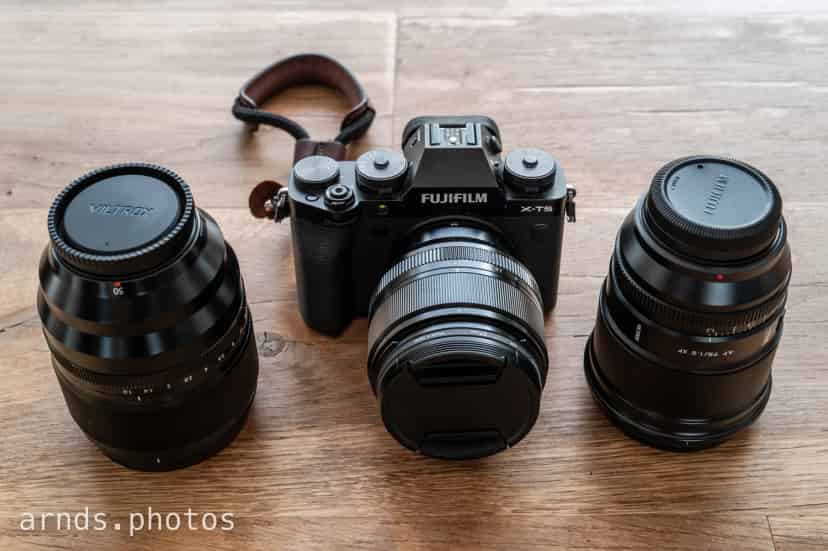
The 3 Best Fuji Portrait Lenses: My X-T5 Comparison
The best Fuji portrait lens: the short answer
If I could only buy one Fujifilm portrait lens, I would choose the XF56mm F1.2 R WR. On APS-C it gives you roughly an 85mm full-frame equivalent, which is the classic portrait field of view. For me it offers the best balance of rendering, sharpness, size and everyday usability.
- XF56mm F1.2 R WR: the best all-round option for portraits, couples, studio and editorial work
- XF50mm F1.0 R WR: the most distinctive lens in this comparison, with the strongest personality
- Viltrox AF 75mm F1.2 Pro XF: the best choice if you want maximum compression and a lot of look for the money
Why this comparison matters on Fujifilm
On Fujifilm APS-C, small focal length differences change the visual language more than many photographers expect. 50mm, 56mm and 75mm become roughly 76mm, 85mm and 115mm in full-frame terms. That is why these three lenses feel so different in real portrait work.
I compared them on the 40.2MP Fujifilm X-T5. A sensor like that reveals very quickly whether a lens is genuinely convincing wide open or only impressive on paper.
My test setup
This is not a lab test. It is a practical comparison built to show four things clearly:
- centre sharpness
- transition from focus to blur
- bokeh and background compression
- colour fringing, especially longitudinal chromatic aberration
I used the same core setup as in the original post: ISO 250, lens wide open, camera-controlled shutter speed, Negative Pro Std., and no extra editing apart from export. If you want to inspect the files yourself, you can download the full-resolution images from my gallery.
Fuji portrait lenses compared directly
| Lens | Full-frame equivalent | Weight | Minimum focus distance | My short verdict |
|---|---|---|---|---|
| Fujinon XF50mm F1.0 R WR | 76mm | 845g | 0.7m | The most artistic look, but also the heaviest specialist tool |
| Fujinon XF56mm F1.2 R WR | 85mm | 445g | 0.5m | The best Fuji portrait lens overall in my view |
| Viltrox AF 75mm F1.2 Pro XF | 115mm | 670g | 0.88m | Extremely strong for headshots and outdoor portraits with heavy compression |
The technical specs come from the official product pages for the Fujifilm XF50mm F1.0, the Fujifilm XF56mm F1.2 WR and the Viltrox 75mm F1.2 Pro XF.
1. Fujinon XF50mm F1.0 R WR: the lens with the most personality
The XF50mm F1.0 R WR is not the sensible option. That is exactly why it is so interesting.
Fujifilm describes it as the world's first autofocus F1.0 lens for mirrorless cameras. On Fuji APS-C it behaves like a 76mm portrait lens, but it also weighs 845g and only focuses down to 0.7m. You feel that immediately in the hand and in the way you work. This is not a lens you casually throw into a bag. It is a deliberate choice for a particular kind of rendering.
What I love about it is the atmosphere. Images often feel larger, softer and more cinematic. The bokeh has personality, subject separation is dramatic and the transition zones feel less clinical than many modern, fully corrected lenses. That is why it occasionally reminds me of what people love about Noctilux-style images.
The downside is just as clear: in hard contrast you will see more fringing than with the 56mm or the Viltrox, and the size makes it less appealing for long handheld sessions or tighter spaces.
If you care more about soul and image character than test-chart perfection, the XF50mm F1.0 remains one of the most fascinating Fuji portrait lenses. Fujifilm's official pages are here and here.
2. Fujinon XF56mm F1.2 R WR: the best Fujifilm portrait lens for most people
The XF56mm F1.2 R WR is the sweet spot in the Fuji system for me. It gives you the classic 85mm equivalent portrait look, weighs only 445g, and focuses as close as 0.5m. That shorter minimum focus distance alone makes it much more versatile for tighter portraits, hands, detail shots and still-life work.
It also brings genuinely useful features: 11 aperture blades, nine weather seals, and operation down to -10°C, according to Fujifilm. In practice, it is the lens I would take without hesitation if I had to choose only one portrait lens for the X-T5.
It looks cleaner and more modern than the 50mm F1.0. Wide open it is very sharp, the bokeh stays calm, and it balances character with reliability better than the other two lenses here. For studio work, available light, couples sessions and classic single portraits, it is the safest recommendation in this group.
So if you are searching for the best Fuji portrait lens rather than the most exotic one, the XF56mm F1.2 WR is the most convincing answer.
3. Viltrox AF 75mm F1.2 Pro XF: the value surprise
The Viltrox AF 75mm F1.2 Pro XF is the outsider here, but also the lens with perhaps the strongest value proposition. It gives you roughly a 115mm equivalent field of view, weighs about 670g, has 11 aperture blades, STM autofocus, a 0.88m minimum focus distance and a 77mm filter thread.
In real images that translates into strong compression, very clear subject separation and a look that can feel extremely refined for outdoor headshots and tighter portrait framing. At the same time, that focal length is often too long for small studios, cramped interiors or fast-moving documentary-style portrait sessions.
In my comparison the Viltrox comes surprisingly close to the Fuji 56mm optically. If you mainly work outdoors, love headshots and do not mind the longer working distance, it is a serious alternative. More details are on the official Viltrox product page.
Which Fuji portrait lens fits which kind of work?
- If you want one lens for almost everything: XF56mm F1.2 R WR
- If you want the most distinctive rendering: XF50mm F1.0 R WR
- If you want outdoor headshots, compression and value: Viltrox AF 75mm F1.2 Pro XF
- If you often shoot in smaller spaces or for longer handheld sessions: XF56mm F1.2 R WR
- If you enjoy working slowly and deliberately with a heavier lens: XF50mm F1.0 R WR
Image comparison: one scene, three very different visual languages
These three sample images show the real point of the comparison. The difference is not only sharpness. It is the way each lens draws space, background and transitions.


FAQ: Fuji portrait lenses
What is the best Fuji lens for portraits?
For most photographers the XF56mm F1.2 R WR is the best choice because it combines the classic 85mm look with high sharpness, beautiful bokeh and strong day-to-day usability.
XF50mm F1.0 or XF56mm F1.2 for portraits?
Choose the XF50mm F1.0 if you want the more unusual, more artistic rendering and do not mind the weight. Choose the XF56mm F1.2 WR if you want the more balanced and practical lens.
Is the Viltrox 75mm F1.2 too long for Fuji portraits?
Not necessarily. For headshots, tighter portraits and outdoor work it is excellent. In smaller rooms or for more spontaneous portrait shooting, though, 56mm is usually more flexible.
My conclusion
If I had to keep only one Fuji portrait lens, it would be the XF56mm F1.2 R WR. It is not the most extreme lens in this comparison, but it is the one with the best balance.
The XF50mm F1.0 R WR remains my choice for character and image poetry. The Viltrox AF 75mm F1.2 Pro XF is the most exciting alternative if you want a lot of visual impact for comparatively little money.
If you want to see how these focal lengths feel in real client work, have a look at my studio portraits in Palma.
Sources and further reading
More Posts
Airports: Light, Shadow, and Solitude
i've spent a lot of my life at airports. between hurrying and waiting, i found amazing architecture and stunning plays of light and shadow.

What to Wear: The Ultimate Kids Photoshoot Outfit Guide for Mallorca
Natural and Carefree: Setting Your Kids Up for a Great Session As a kids photographer in Mallorca, the most common question I get from parents is: "W...